Thursday, 24 January 2013

St Dwynwen's Day


The 25th of January is St Dwynwen’s day, the patron saint of Welsh lovers. Recently a tradition of celebrating St Dwynwen’s day as our equivalent of St Valentine’s has become established. St Dwynwen herself was an early Celtic saint who lived in 5th Century Anglesey.


There are a few variations in St Dwynwen’s legend, but the most common one is as follows:

Dwynwen was a young woman who was in love with a young man named Maelon, but Maelon betrayed her trust by forcing himself on her. After praying for assistance, an angel provided her with a potion, which enabled her to forget her love for Maelon, and which punished him for his crime by turning him into a pillar of ice.

Taking pity on Maelon, Dwynwen then prayed for three requests. Those three requests were that Maelon be released; that, through her, God would look after all true lovers; and that she herself should remain unmarried. She then retreated to the solitude of Llanddwyn Island off the west coast of Anglesey to become a hermit until she died, in about AD 460.

A rather sad tale for a patron saint of lovers.

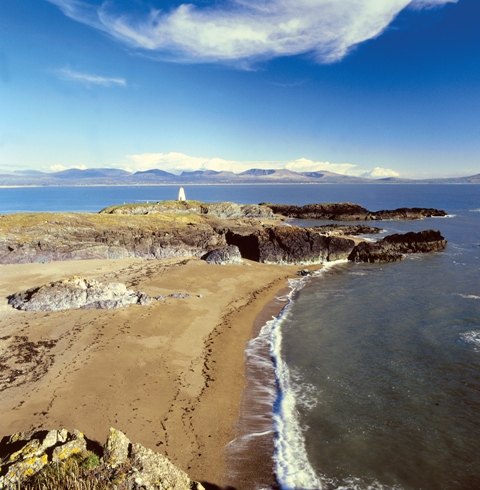
Llanddwyn Island itself is in a beautiful location on the south west corner of Anglesey. The island can in fact be walked to from the mainland at low tide, and is the site of a small church. There are lovely views across the sea to Snowdonia, and a charming little lighthouse nearby, which was used as a location for the (rather indifferent) Demi Moore film “Half Light”.

The area is a good base for walks.


Tuesday, 2 October 2012

National Trust Great British Walks

The National Trust are listing a new series of walks on National Trust owned land. There are 1288 across the whole of the UK, of which 33 are in North Wales.

These include Cnicht from Croesor - a moderate walk of 6 and a half miles. Or for more coastal scenery there's a walk on the Cemlyn Shingle Ridge. Many of the routes have step by step guides marked on OS maps.

Nordic Walking in Beddgelert Forest

Caroline Moncrieff runs courses on Nordic Walking on the Llyn Peninsula and elsewhere in North Wales. This Friday she's going a bit further afield to Beddgelert Forest. This is from her newsletter. If you would like to join in, please contact her using her details below:

Beddgelert Forest TAITH NORDIG


Friday / Dydd Gwener : 5th October  /  Mis Hydref
Meeting Time / Amser cwrdd:    10.30 AM/YB  

Meeting point / Man cwrdd: Take the turning at the Pont Cae Gors sign,then follow the track down and you will come to a car park at the start of the walks. ( If you are coming from Beddgelert you drive past the campsite on your left, the take the Pont Cae Gors turning on the left, the road goes back down on yourself.) If you want to meet up to car share let me know.

Weather / Tywydd: SUNSHINE WITH A LITTLE CLOUD AND MAYBE RAIN

We will have a walk around the forest, bring something to eat, as we can walk up to the lake and have lunch there.

Please let me know if you are coming or bringing a friend, so I have enough Nordic Poles for the session.  Can you also pass this information on to anyone you think would be interested in joining our Nordic Walks.


Thank you /Diolch


Caroline
carolinemoncrieff@yahoo.com
07980 538811

Monday, 1 October 2012

Bwlch y Groes-Hellfire Pass

Bwlch y Groes actually translates as "Pass of the Cross". The English name "Hellfire Pass" is a mis-translation and is not used locally. It is so named because it was the Pilgrim's route from North West Wales to St David's. There has been a cross on the site marking the way since medieval times. The current cross has existed since 1989.


High passes and the Red Bandits of Mawddwy

I was driving through Southern Gwynedd the other day and took these photos of the pass Bwlch Oerddrws near Mallwyd.


This is the route I took - slightly off the beaten track!


Looking into the history of this area , I discovered the legend of the Red Bandits of Mawddwy. These were a band of red-haired highwaymen who terrorised this area in the 16th century, circa 1555.

National Slate Museum, Llanberis


My visit to Llanberis gave me the opportunity to visit the Slate Museum at Llanberis where the history of slate mining is well explained in models, film and arifacts. The setting is the workshops and finishing area for the Asheton Smith quarries.
The largest working watermill in Great Britain. According to the information plaque - "50' 5" in diameter, 5' 3" wide, and built around a 12" axle, it was constructed in 1870 by De Winton of Caernarfon, Gwynedd. The original was replaced in 1925 by a Pelton wheel or turbine, (still in use), but remarkably the water wheel was not scrapped. Restored to full working order in 1982, it is powered by water from the opposite side of the valley, carried by a 2' diameter cast iron pipeline."
Dinorwig workshops. "Whilst the surrounding mountains echoed with blasting, this building, Dinorwig workshops, built in 1870, serviced all the needs of the quarry. Over 100 men were employed here - with skills to make the operation self-sufficient. Wood from local trees was lifted in by crane to make trucks and engines for slate transport. In the smithy and foundry, men built and repaired machinery. Pattern makers crafted huge wooden patterns for metal machine parts. The giant water wheel gave power."

Here is a list of the many North Wales slate quarries that once existed. Only a few of them now remain.

How the price of slate has risen in value !

No traitors live here! 
This was a common sight at the time of the Great Penrhyn Strike and can be seen in the window of one of the cottages reconstructed at the National Mining Museum at Llanberis. This strike was one of the most bitter in North Wales' industrial history. You can read more about the history of this important strike at the Snowdonia National Park website.

This is a terrace of former miner's cottages. The information board at the front reads:

"This terrace of houses, Fron Haul, was built in the village of Tanygrisiau, near Blaenau Ffestiniog, as homes for slate quarrymen. Here, the houses are furnished to reflect important  periods in the history of the slate industry.
In no 3 lives a slate worker's family of 1861, crammed alongside their lodgers, exploiting the boom years of slate. No 2 is a house at Bethesda, during the bleak Penrhyn strike and lockout of 1900-03. The family struggles to survive, but a placard in the window says "There is no traitor in this House". No 1 is set in Llanberis in 1969: Dinorwig Quarry has closed, the father has no job, the future is uncertain. No 4 is used for educational projects on the lives of quarrymen and their families."

Interior circa 1870


Interior circa 1970

Sunday, 30 September 2012

VIPs at the Quarry Hospital


I had the pleasure to be invited to the launch of the Ein Treftadaeth / Our Heritage initiative, a 1.8 million £ scheme to improve the way we bring history and culture to life for residents and tourists alike. Walking will be a big feature of this initiative because it will sponsor the creation of the route for the Pilgrim Way North Wales, a 12 day walk from Holywell to Bardsey Island see www.pilgrim- way-north-wales.org ‘Ein Treftadaeth’/’Our Heritage’ is a £1.7m project to provide an integrated approach to heritage tourism across Gwynedd, Conwy and Snowdonia National Park.
The aim is to maximise the economic value of the area’s heritage, by increasing the volume, length and the value of visits. Gwynedd Council is leading the consortium in partnership with Conwy Borough Council and Snowdonia National Park. Minister for Housing, Regeneration and Heritage Huw Lewis said
"Our historic environment is one of our most precious economic and social assets. It makes a powerful contribution to tourism and Wales’ attractiveness to investors. It can also contribute significantly to regeneration.
“I am therefore extremely pleased to be here today to congratulate Gwynedd Council and their partners who are developing such an imaginative project, which will celebrate the diversity and distinctiveness of the heritage of North West Wales.”

Gwynedd Council’s Economy Cabinet Member, Councillor John Wynn Jones said,
“As well as a stunning landscape of mountains and coastline, Gwynedd and the wider North West Wales area has a fantastic story to share with the world - from the Celts and Romans to the Princes of Gwynedd and on to the 19th and 20th century quarries which exported Welsh slate across the globe.
“By packaging our area’s fascinating historical attractions and presenting them within their wider context, the ‘Ein Treftadaeth’/’Our Heritage’ project has the potential to have a significant positive impact upon our growing heritage tourism industry.”
By using both traditional and new technologies, the project aims to deliver improved co-ordinated interpretation including at the Quarry Hospital, Parc Padarn, and Padarn Lake Railway to emphasise the importance of the rail and slate industries.
‘Our Heritage’ is just one of a number of schemes that has benefited from the Welsh Government funded Heritage Tourism Project, bringing to fruition new ideas for attracting visitors to heritage sites in Wales and thereby creating jobs in our communities.
The Heritage Tourism Project is a £19 million Welsh Government managed initiative, backed by the European Regional Development Fund, to develop heritage tourism across Wales. The success of the project hinges on an integrated presentation of heritage sites and the development of meaningful and memorable storylines, making connections between sites, places, people and communities.


 The staff at the old quarry hospital love to bring history alive. Here is matron discussing the use of bedpans with Dewi Davies Strategy Director of TPNW.